Even today, TCM (Traditional Chinese Medicine) remains relatively unfamiliar in the West and is sometimes subject to misconceptions. It may be perceived as an ancient practice, or even as something disconnected from modern needs.
Yet TCM is part of a comprehensive and coherent approach to maintaining vitality, with its own understanding of the human body, how it functions and how imbalances can arise. It has developed through the observation of nature and the experience accumulated by generations of practitioners and scholars.
In Montpellier, this approach can be explored through various hands-on practices, including Tuina massage, Chi Nei Tsang abdominal massage, Chinese foot reflexology and cupping therapy.
Each of these techniques aims to support vitality, reconnect you with your body, and promote serenity and well-being in everyday life.
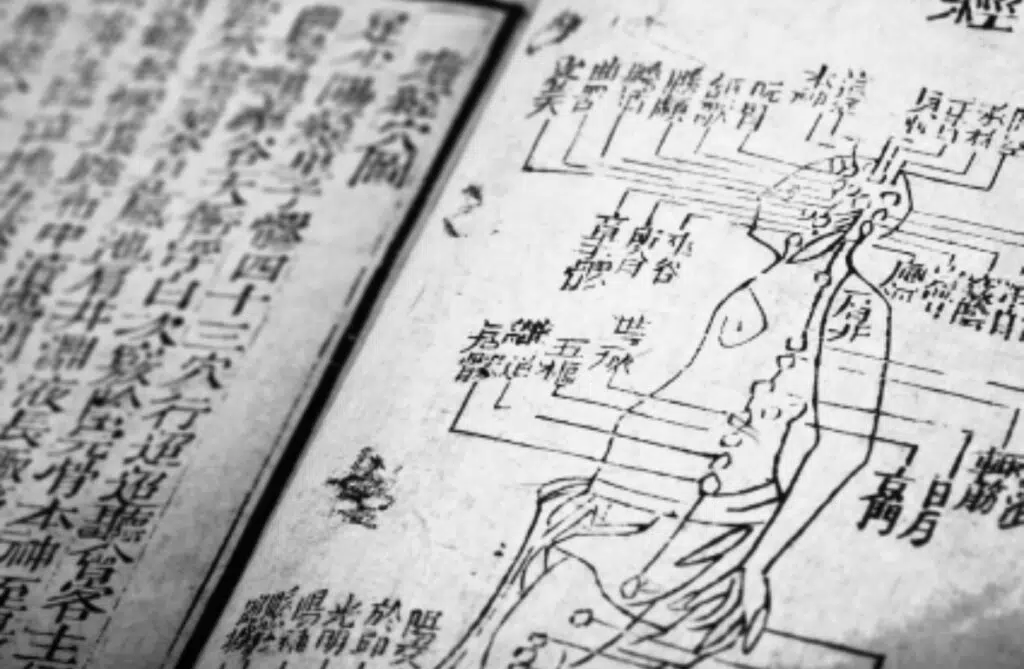
The Main Principles of TCM
Qi, Vital Energy
The Qi is a fundamental concept in TCM. It is considered the very principle of life and flows throughout the body.
According to this understanding, Qi is involved in all bodily functions: its movement, transformations and interactions are associated with physical and mental vitality.
Energetic balance largely depends on the harmonious flow of Qi. When this dynamic is disrupted, TCM seeks to understand the nature of the imbalance in order to adapt its approach.
Yin and Yang
Meridians and Acupoints
According to TCM, the body is traversed by a network of energy channels known as meridians.
They facilitate the circulation of Qi and Blood and connect different parts of the body. The meridians therefore form a true energetic map, establishing correspondences between the surface and the deeper layers, as well as between different organs and regions of the body.
Acupuncture points, located along these meridians, are specific areas that can be stimulated through various TCM practices, including acupuncture, massage and moxibustion, to address certain imbalances and support overall balance.

The Five Phases Theory
Wood 木
Fire火
Earth 土
Metal 属
Associated with autumn, the Lungs and the Large Intestine, Metal evokes clarity, discipline and the ability to let go. Sadness is also associated with this phase.
Water 水
Corresponding to winter, the Kidneys and the Bladder, Water symbolizes depth, memory and wisdom. Fear is associated with this phase.
The Five Phases are in constant relationship with one another. They provide a framework for observing the interactions between the organs, emotions, seasons and different aspects of everyday life.
The Zang-Fu Theory: Organs and Viscera
The Causes of Imbalances According to TCM

How Does a TCM Energetic Assessment Work
- Observation
- Hearing and Smell
- palpation
- Questioning
Observation
Hearing and Smell
Palpation
Questioning
Questioning (wèn zhěn, 问诊) involves gathering information through specific questions about the person’s medical history, allergies, previous health conditions, the history and progression of symptoms, as well as the circumstances in which they improve or worsen.
The practitioner may also ask about sensations of heat and cold, sweating, pain, emotional state, sleep, appetite, digestion, urination and bowel movements.

TCM practices
TCM encompasses a variety of methods and practices, including Chinese herbal medicine, acupuncture, moxibustion, Chinese massage and Chinese dietary therapy.
In Montpellier, the hands-on approach offered focuses on Tuina massage, Chi Nei Tsang abdominal massage and Chinese foot reflexology, with the option of incorporating Chinese cupping, moxibustion and Gua Sha as complementary techniques.
Chinese Massage
Tuina Massage
- Relieve tendon and muscle pain and tension
- Support athletes before and after physical activity
- Promote deep relaxation and a sense of calm
- Support people experiencing sleep issues, digestive issues or headaches
- Contribute more broadly to improving vitality

Chi Nei Tsang

Chinese foot reflexology

Cupping therapy
Chinese cupping is a complementary technique that can be incorporated into different treatments. During a Tuina massage, it is generally used at the end of the session.
Unlike Tuina, which works through deep pressure and mobilization, cupping uses suction to draw the tissues outward. This action helps mobilize the fascia, release tissue adhesions and provide lasting relief from muscle tension.

Other TCM Practices
Chinese pharmacology
Chinese herbal medicine (zhōng yào, 中药) involves the use of medicinal substances, primarily of plant origin and, more rarely, mineral origin. Animal-derived substances are now very rarely used.
Acupuncture
Moxibustion
Moxibustion (ài jiǔ, 艾灸) involves burning the leaves of a variety of mugwort, either at a distance from or directly on the skin, over specific areas of the body.
Chinese dietary therapy

Discover TCM in Montpellier
TCM offers a structured approach based on fundamental theories, an energetic assessment and various practices.
In Montpellier, hands-on treatments focus primarily on Tuina massage, Chi Nei Tsang and Chinese foot reflexology. Complementary techniques such as cupping may also be incorporated according to each person’s needs.
Certified TCM Practitioner in Montpellier
I continuously develop my skills through advanced training and the ongoing development of my practice. In 2025, I completed a clinical Tuina training program in China at Shuguang University Hospital. In 2026, I am continuing this journey through further training.
My personal journey, enriched by travel and the practice of disciplines such as Ayurveda, meditation, yoga, breathwork and tantra, also deepens my connection with others.
Convinced that self-awareness contributes to the quality of care, I strive to cultivate presence, attentive listening and integrity in my practice. Each session is therefore designed as a safe and non-judgmental space, where your experience is welcomed with care and where the body can express itself freely.

Massage studio in Montpellier and in-home sessions
I welcome you to my massage practice in Montpellier, near Bois de Montmaur, in a calm and peaceful setting conducive to relaxation.
I also offer home sessions in Montpellier and the surrounding towns: Le Crès, Montferrier-sur-Lez, Prades-le-Lez, Vendargues, Baillargues, Fabrègues, Cournonterral and Cournonsec.
Each session is tailored to your needs to provide personalized care in a comfortable and confidential setting.
Practice address
2146 route de Mende, 34090 Montpellier
(Tram line 5 – CNRS / Zoo de Lunaret stop – Bois de Montmaur parking)
EXCELLENT Basée sur 29 avis
 Publié sur Google
 Thomas Esnoult-MartinelliJ'ai été très satisfait du soin / massage que Yoann m'a procuré. J'avais autant besoin d'une remise à niveau énergétique qu'un travail musculaire profond et toutes les cases ont été cochées 👍🏻 Yoann est très attentif bienveillant et le soin de 2h30 est un vrai voyage ! Bravo et merciPublié sur Google
 Sebastien DSuper expérience pour mon premier massage de médecine traditionnelle chinoise, que je recommande vivement ! Yoann était à l’écoute et a structuré le massage en fonction de mes besoins. Professionnel, et plein d’empathie, cette séance avec Yoann m’a apporté beaucoup de relaxation et de calme. Il m’a aussi donné des conseils en diététique et automassages qui me seront très utiles pour la suite.Publié sur Google
 ANNEUn temps suspendu, voilà ce que je retiens de ce moment ( massage Tui Na). Yoann est à l'écoute, professionnel, compétent, bienveillant. Si vous aussi, vous avez envie/besoin d'un peu de confort et réconfort, n'hésitez pas Yoann sera là pour vous. Merci encore Yoann.Publié sur Google
 nolhan gevaudanBelle découverte du massage chinois à Montpellier. J'ai reçu deux massages énergétiques différents et je recommande leurs bienfaits à ceux qui veulent se relaxer profondément ou soulager les tensions du quotidien. Il m'a aussi posé des ventouses qui m'ont permis de calmer une douleur à l'omoplate. Yoann est attentif et bienveillant et il prends son temps pour vous connaître et adapter au mieux ses prestations. Si vous êtes sportif et recherchez un vrai massage profond n'hésitez pas !Publié sur Google
 Guillemette JozanJe conseille vivement Yoann pour ces séances. A l’écoute, intuitif et bienveillant il m’a permis en une seule séance de débloquer beaucoup blocages ✨🙏 Merci encore mille fois ✨Publié sur Google
 Marina GrobostUne très belle rencontre thérapeutique. Vous pouvez prendre rendez-vous avec Yoann les yeux fermés. C'est quelqu'un de très compétent, passionné par ce qu'il fait, et surtout d'une profonde bienveillance. Le cadre est apaisant, il est très doux dans son approche et il prend le temps nécessaire pour offrir un soin de qualité sur-mesure, précédé et suivi d’un temps d'échange constructif où Yoann donne de précieux conseils. On se sent écouté et entre de très bonnes mains. Un immense merci !Publié sur Google
 Flore FaveyrialMassage incroyable, une bulle de bien-être, de détente et de temps pour soi. Yoann est un professionnel hors pair, à l'écoute et d'une grande bienveillance. Je recommande vivement ses soins à toute personne souhaitant s'accorder un moment de ressourcement et de régénération.Publié sur Google
 Dany GuillemoteauJ'ai consulté Yoann tout à fait par hasard et je ne regrette pas mon geste. Yoann a fait preuve d'un grand professionnalisme et a à coeur de vouloir bien faire en personnalisant ses soins en fonction des besoin de ses patients. Je recommande Yoann les yeux fermés pour un bien-être garanti dès la première séance.Publié sur Google
 Valerie VRJ’ai connu yo a l’école de médecines traditionnelles chinoises à Paris , il était déjà très appliqué et impliqué ! C’était un très bon élève …à tout point de vue ! À l’époque, j’imaginais déjà son devenir dans le milieu …gagné : il a réussi ! Et après un massage par cet ancien collègue de promo, récemment , …je constate que Yo a su s’approprier les méthodes en y mettant sa touche perso : le magnétisme et puis la rondeur de chacun de ses gestes ! 🎈rassurant , enveloppant, soulageant etc …bref ! c’est un très bon professionnel avec un bon état d’esprit et un grand cœur ! ❤️ Je recommande ! Profitez en : il est près de chez vous , car moi, si je veux le voir : je dois traverser la France !! Bon massage …à découvrir …Publié sur Google
 Aurelie DijouxYohan est un praticien à l'écoute et disponible. Très compétent et j'ai apprécié le massage qui a été très intense mais bénéfique. Je recommande à 100% et reviendrai bientôt c'est surCertifié par: TrustindexLe badge vérifié de Trustindex est le symbole universel de confiance. Seules les meilleures entreprises peuvent obtenir le badge vérifié, avec une note supérieure à 4.5, basée sur les avis des clients au cours des derniers 12 mois. En savoir plus
Chinese massage does not constitute a medical diagnosis under any circumstances. It is not a substitute for physiotherapy or medical care provided by a general practitioner, specialist or any other qualified healthcare professional.
TCM is recognized by the World Health Organization (WHO) as one of the traditional medicine systems used in many healthcare systems around the world.