Back pain is a common reason for consultation in Montpellier, whether it involves lower back pain, muscle tension, blockages such as lumbago, chronic lower back pain, or a lumbar disc herniation/sciatica.
These pains can develop gradually or appear suddenly, and can have a real impact on daily life: discomfort when moving, stiffness upon waking, difficulty standing or sitting for long periods.
In Traditional Chinese Medicine (TCM), these imbalances are generally linked to a disruption in the circulation of Qi and Blood in the body. Tuina massage helps relieve tension, release blockages, and promote better mobility of the back.
In Montpellier, I support people suffering from back pain with a personalized approach based on Traditional Chinese Medicine.
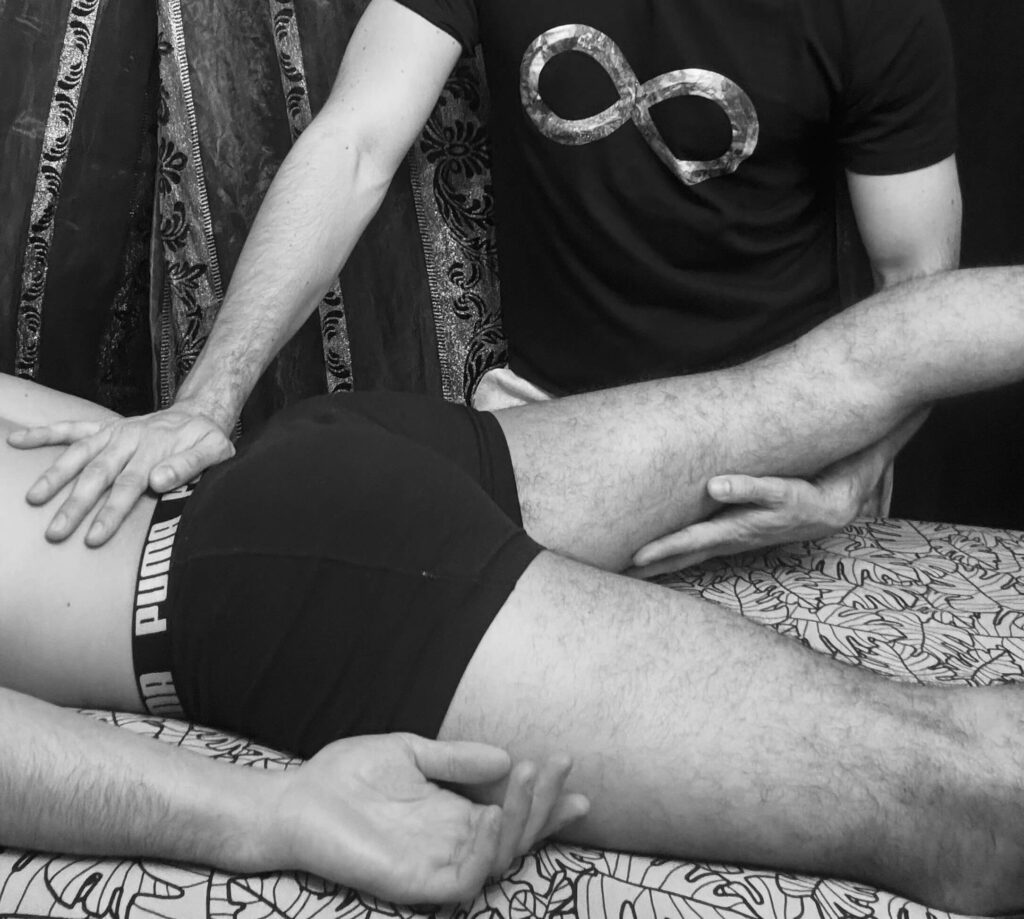
Back pain according to Traditional Chinese Medicine
Lumbar muscle pain
The lumbar muscles are constantly engaged in everyday movements. They ensure trunk stability, maintain posture, and are involved in many movements. Due to their continuous activity, they are particularly exposed to tension and overload.
The lumbar muscles
The main muscle groups are as follows:
- The sacrolumbar common mass originates from the sacrum, the iliac crest, and the lower lumbar vertebrae. Very powerful, it is made up of several deep muscle bundles that cannot be individually distinguished during a massage.
- The quadratus lumborum: a key muscle of the lumbar region, it has three fiber orientations. It is particularly involved in trunk rotation and lateral flexion movements.
- The iliopsoas: a deep muscle connecting the spine to the femur, it plays a major role in hip flexion and directly influences lumbar mechanics.
- The abdominal muscles, especially the transversus abdominis muscle. A true natural belt, it is essential for lumbar stability and works in synergy with the diaphragm during breathing.
- The oblique muscles (internal and external), mainly involved in trunk rotation and lateral flexion movements.
- The rectus abdominis, whose role in lumbar mechanics is more limited than that of the transversus abdominis and the obliques.
Possible causes of lower back tension
Overuse of the lumbar muscles and back pain can have several origins:
- The aftereffects of a lumbar condition (lumbago, lumbar sprain, etc.) that has not fully recovered. To avoid pain, the body sometimes adopts postural compensations that gradually create muscular tension and imbalances.
- Certain morphological abnormalities, such as scoliosis or bone asymmetry (for example, a more developed transverse process on one side), which lead to chronic overload of certain muscles.
- Aging: with age, muscles are less well vascularized and less well nourished. They recover less easily after exertion and become more sensitive to tension and overuse.
- Excessive strain, linked to repetitive movements (for example in athletes, tennis players, or cashiers) or prolonged maintenance of a posture requiring continuous muscle contraction.
Do you recognize these back pain symptoms?
Lumbar muscle tension often has very specific characteristics, most commonly manifesting as gradually developing pain that can easily become chronic.
The main signs are:
- A chronic pain that the person is able to describe precisely. It usually decreases at rest but reappears as soon as activity resumes.
- Localized or diffuse pain, which may be unilateral or bilateral, sometimes felt as a horizontal or vertical band in the lumbar region, without a single specific painful point.
- A feeling of muscle fatigue. You have the impression of “carrying your back” and often feel the need to lie down. A good night’s sleep generally provides temporary relief.
- Pain relieved by deep massage and heat. Although the massage may be tender, it provides a sense of well-being by promoting tissue circulation and releasing tension.
- A tendency to worsen in the absence of treatment. Tension gradually builds up. Appropriate physical activity is generally beneficial for maintaining mobility and reducing recurrences.
- Increased sensitivity to cold, wind, and humidity, especially when the condition becomes chronic.
- Imaging tests are most often normal (X-ray, MRI, ultrasound), as this is a functional disorder rather than a visible lesion.
- Preserved mobility. You are generally not blocked and often feel the need to stretch to relieve tension.
- Pain that can be reproduced by palpation and muscle stretching, allowing the affected muscle or muscles to be identified.

Lower back pain and lumbago: back blockages
Lumbago is the acute form of lower back pain. It is characterized by the sudden onset of intense pain in the lumbar region, accompanied by a significant restriction of movement.
Its origin is mainly joint-related. Unlike a sprain, it does not result from excessive stretching of tissues, but from an uncontrolled or overly rapid movement. This sudden strain can cause compression of a joint structure, triggering a pain signal that travels along the nerve pathways. In response, the lumbar muscles contract reflexively to protect the area, leading to a true back blockage.
This protective mechanism greatly limits movement and explains why even the slightest gesture becomes particularly painful.
Common causes of lumbago
Lumbago is an intense form of back pain that most often occurs following a sudden, poorly controlled movement, or a movement combining trunk flexion and rotation. The blockage can appear at different levels of the lumbar spine.
In the absence of appropriate treatment, certain joints may retain reduced mobility, which can promote the development of chronic pain and tension.
In Traditional Chinese Medicine, cold and dampness can also contribute to the onset of these blockages by making the tissues less flexible and more sensitive (painful Bi syndromes).
Symptoms of back blockage in Traditional Chinese Medicine
In Traditional Chinese Medicine (TCM), an acute back blockage is often interpreted as a stagnation of Qi and Blood, reflecting a significant obstruction of energy circulation in the lumbar region.
The main symptoms are:
- Intense, stabbing pain described as knife-like, sometimes pulsating, especially at night.
- A significant inability to move, with severe functional limitation.
- Hypersensitivity to palpation, with the patient possibly refusing touch and generally not being relieved by massage.
- A characteristic antalgic posture, often with a forward-leaning position and a cautious gait.
- A limitation of daily activities, such as sitting down, lying flat, or turning over in bed.
- Possible worsening of pain when coughing or breathing, increasing lower back pain.
Lumbar disc herniation and pain
A lumbar disc herniation refers to the posterior or lateral protrusion of an intervertebral disc in the lumbar region, which can lead to compression of ligament structures or nerve roots. It may cause lower back pain and/or sciatica.
Causative factors in TCM
In Chinese Medicine, this type of disorder is generally classified under the categories of “pain in the lower back and lower limbs,” trauma, or Bi syndrome (painful obstruction).
The causes are usually multiple:
- Internal causes: progressive wear of the disc, dehydration, fissures, and weakening of the disc structures.
- External causes: trauma, overuse leading to reduced nourishment of the disc, as well as the influence of cold, which causes muscular and vascular contractions. This disrupts local circulation, reduces the disc’s nutrient supply, and promotes blockages and pain.
Pain manifestations of lumbar disc herniation
Most people present with lower back pain that has been evolving for several weeks or months, or a history of recurrent painful episodes.
The intensity varies, and the pain may be worsened by coughing, sneezing, or straining during bowel movements.
The main associated signs are:
- Radiation of pain into the lower limb (sciatica)
- Limited lumbar movement, sometimes associated with motor disorders.
- Deformation of the lumbar spine, with lateral tilt or loss of the normal physiological lordosis.
- Sensory disturbances, such as numbness in the outer or posterior side of the leg, the top of the foot, the heel, or the sole of the foot.
- A sensation of cold in the affected limb.
- Muscle atrophy, particularly in the gluteal region and the affected lower limb.
- Pain on pressure over the vertebral spinous processes at the affected levels.

Tuina Massage to relieve back pain in Montpellier
Before the Chinese massage sessions in Montpellier, we always begin with an energy assessment that allows me to get to know you and your personal history. This helps me understand your environment and better grasp your emotional sphere, in order to establish a tailor-made massage protocol.
Energy assessment and analysis of back pain
Energy assessment according to Traditional Chinese Medicine
This assessment is based on a global observation, in accordance with the principles of Traditional Chinese Medicine, which considers the person as a whole. It includes the observation of posture and tissues, palpation of areas of tension, a general interview about your lifestyle, as well as tongue examination and pulse diagnosis, which are true indicators of the internal state.
We also discuss your associated symptoms, whether digestive, emotional, or physical, in order to better understand the existing imbalances and how they manifest in the body.
Emotional causes of back pain
In Traditional Chinese Medicine (TCM), back pain and lower back pain may be related to the Kidney energy system, considered the root of vital energy, deep vitality, and overall strength. The Kidneys are also associated with bone structure, the lower back, and the body’s ability to recover and regenerate over time.
On an emotional level, this system is linked to fear. When fear is chronic or unexpressed, it can weaken Kidney energy and manifest in the body as a feeling of lower back weakness, deep fatigue, or recurrent pain in the lower back.
According to Chinese thought, back pain can therefore also be related to:
- Chronic fear (material fear, fear of lack, fear of the future)
- Difficulty moving forward in life, a feeling of being blocked.
- Repression of sexual energy.
- A lack of self-confidence and trust in life.
- Prolonged stress and worries.

Tuina Massage for lower back pain
Tuina massage in Montpellier is particularly recommended for back pain and lower back pain, as it helps release muscle tension and promotes better energy circulation in the lower back region.
If you suffer from lower back pain, blockages, or chronic tension, I support you in Montpellier with a personalized approach based on Traditional Chinese Medicine.
General principles for the management of lower back pain using Chinese massage:
- Unblock the meridians, activate Qi and Blood
- Relax the tendons, soften hardness, and disperse knots
- Lubricate the joints, eliminate adhesions, and promote joint congruence
- Maintain and improve joint mobility
- Relieve pain
Customized Tuina Chinese massage protocol
During the energy assessment, we will also have identified the muscles most affected by the back pain involved (psoas, quadratus lumborum, etc.), as well as any possible functional disorders, limitations in range of motion, or osteoarthritis.
The massage protocol will therefore be fully personalized and always carried out according to the principles of Traditional Chinese Medicine.
Here is a basic protocol for relieving back pain in Montpellier in my Chinese Massage practice:
- Massage of the back and sacrum:
- Tui Fa 推法 on the back: a pushing technique that activates Qi and Blood.
- Fen Tui Fa 分推法 on the dorsal area: a technique that involves pushing while separating tissues or structures on both sides (dispersing what is stagnant).
- Gun Fa 滚法 on the lumbar region and sacrum: a rolling technique combining wrist flexion/extension and pronation–supination movement (warms the meridians, relieves pain and muscle spasms).
- Rou Fa 揉法 on the lumbar area: a deep kneading massage technique applied to the tissues (to break down fibrous adhesions and disperse muscle knots).
- An Fa 按法: a sustained or gradual pressure technique applied to a point or area, using the thumbs, palm, or elbows (analgesic, calming, and energizing effect).
- Tan Bo Fa 弹拨法: a scraping and plucking technique applied with pressure (strong vascular stimulation).
- Na Fa 拿法: a grasping and kneading technique applied to the tissues (relaxes and loosens the muscles).
- Nie Fa 捏法: a pinching and gentle kneading technique applied to the skin and superficial tissues (releases the surface layer).
- Bo Fa 拨法: a technique consisting of pulling or moving tissues, tendons, or superficial structures (releases tension and restores the free circulation of Qi).
- Ca Fa 擦法 on the lumbar region: a rapid friction technique applied to the tissues (warms the meridians and disperses stagnation).
- San Fa 散法 on the lumbar region: a technique aimed at dispersing stagnations.
- Ji Fa 击法 on the sacrum: a rhythmic percussion technique applied to the tissues (muscle activation and release).
- Pai Fa 拍法: a rhythmic tapping technique using the palm or the edge of the hand (stimulates the circulation of Qi and Blood).
The acupuncture points commonly stimulated for lower back pain, using these massage techniques, are: Shenshu 23V, Zhishi 52V, Baihuanshu 30V, Zhibian 45V, and the Baliao points.
- Gluteal and hip massage: gluteus maximus, gluteus medius, and piriformis muscle, especially the Huantiao 30GB acupuncture point.
- Massage of the posterior lower limb: the Bladder meridian, along the back of the leg, is a key focus during massage for back pain, with stimulation of the following acupuncture points: Chengfu 36V, Yinmen 37V, Weizhong 40V, Chengshan 57V, as well as Yanglingquan 34GB.
- Massage of specific reflex zones of the foot: stimulation of the following acupuncture points: Qiuxu 40GB, Shenmai 62BL, Zulinqi 41GB, Taixi 3KI, and Kunlun 60BL.
- Disc decompression and pumping techniques for lumbar disc herniation

Stretching, joint mobilization, and cupping therapy (Hijama) to relieve back pain
For a comprehensive treatment, the massage may be complemented by gentle joint mobilization and targeted stretching, including overall lumbar mobilization, as well as stretching of the spinal muscles, the tensor fasciae latae (TFL), the psoas, and the piriformis.
Chinese cupping therapy (Hijama) is generally used at the end of the session to help relieve tissue congestion, stimulate the local circulation of Qi and Blood, and dissipate deep-seated tension accumulated in the lower back region.

Personalized advice after a Tuina Massage for back pain
Chinese dietary therapy and tissue nourishment
At the end of your massage session in Montpellier, I also provide personalized advice tailored to your constitution and specific imbalances, helping to prolong the benefits of your Tuina massage.
In Chinese Medicine, diet plays an essential role in the health of the body’s tissues, particularly the muscles and deeper structures.
The Liver, associated with the flexibility of muscles and tendons, is supported by foods that promote circulation and tissue vitality, such as green vegetables (spinach, broccoli, Swiss chard), fresh herbs, lemon, beetroot, and mildly sour foods.
The Kidneys, which are linked to the strength of the bones, lower back, and deep vitality, are nourished by rich, concentrated foods such as legumes, whole grains, nuts and seeds (especially walnuts and black sesame), slow-simmered broths, and dark-colored foods (black beans, blueberries, prunes).
These recommendations are always adapted to your individual constitution in order to support the body’s long-term balance and help prevent recurring tension.
Self-massage to relieve lower back tension
After the treatment, I also offer personalized self-massage advice tailored to your constitution and specific areas of tension.
It involves stimulating key areas of the lower back region and related zones in order to promote the circulation of Qi and Blood and deeply relax the muscles.
Simple gestures such as slow pressure, friction, or circular movements can be performed on the lower back, the gluteal region, or along the paravertebral muscles.
When practiced regularly, self-massage helps to
- reduce stiffness
- improve mobility
- prevent the recurrence of back pain

I welcome you to my massage practice in Montpellier, located near the Bois de Montmaur. You will find a calm, authentic, and soothing space, conducive to relaxation and reconnecting with yourself.
Massage Studio Adress
2146 route de Mende, 34090 Montpellier
(Tramway 5 – CNRS / Zoo de Lunaret Stop – Bois de Montmaur parking lot)
Home visits are available within a 20 km radius of Montpellier, provided that convenient parking is available nearby, the property is easily accessible (with a lift if located on an upper floor), and there is a quiet, clean, and sufficiently spacious area for the session.
EXCELLENT Basée sur 29 avis
 Publié sur Google
 Thomas Esnoult-MartinelliJ'ai été très satisfait du soin / massage que Yoann m'a procuré. J'avais autant besoin d'une remise à niveau énergétique qu'un travail musculaire profond et toutes les cases ont été cochées 👍🏻 Yoann est très attentif bienveillant et le soin de 2h30 est un vrai voyage ! Bravo et merciPublié sur Google
 Sebastien DSuper expérience pour mon premier massage de médecine traditionnelle chinoise, que je recommande vivement ! Yoann était à l’écoute et a structuré le massage en fonction de mes besoins. Professionnel, et plein d’empathie, cette séance avec Yoann m’a apporté beaucoup de relaxation et de calme. Il m’a aussi donné des conseils en diététique et automassages qui me seront très utiles pour la suite.Publié sur Google
 ANNEUn temps suspendu, voilà ce que je retiens de ce moment ( massage Tui Na). Yoann est à l'écoute, professionnel, compétent, bienveillant. Si vous aussi, vous avez envie/besoin d'un peu de confort et réconfort, n'hésitez pas Yoann sera là pour vous. Merci encore Yoann.Publié sur Google
 nolhan gevaudanBelle découverte du massage chinois à Montpellier. J'ai reçu deux massages énergétiques différents et je recommande leurs bienfaits à ceux qui veulent se relaxer profondément ou soulager les tensions du quotidien. Il m'a aussi posé des ventouses qui m'ont permis de calmer une douleur à l'omoplate. Yoann est attentif et bienveillant et il prends son temps pour vous connaître et adapter au mieux ses prestations. Si vous êtes sportif et recherchez un vrai massage profond n'hésitez pas !Publié sur Google
 Guillemette JozanJe conseille vivement Yoann pour ces séances. A l’écoute, intuitif et bienveillant il m’a permis en une seule séance de débloquer beaucoup blocages ✨🙏 Merci encore mille fois ✨Publié sur Google
 Marina GrobostUne très belle rencontre thérapeutique. Vous pouvez prendre rendez-vous avec Yoann les yeux fermés. C'est quelqu'un de très compétent, passionné par ce qu'il fait, et surtout d'une profonde bienveillance. Le cadre est apaisant, il est très doux dans son approche et il prend le temps nécessaire pour offrir un soin de qualité sur-mesure, précédé et suivi d’un temps d'échange constructif où Yoann donne de précieux conseils. On se sent écouté et entre de très bonnes mains. Un immense merci !Publié sur Google
 Flore FaveyrialMassage incroyable, une bulle de bien-être, de détente et de temps pour soi. Yoann est un professionnel hors pair, à l'écoute et d'une grande bienveillance. Je recommande vivement ses soins à toute personne souhaitant s'accorder un moment de ressourcement et de régénération.Publié sur Google
 Dany GuillemoteauJ'ai consulté Yoann tout à fait par hasard et je ne regrette pas mon geste. Yoann a fait preuve d'un grand professionnalisme et a à coeur de vouloir bien faire en personnalisant ses soins en fonction des besoin de ses patients. Je recommande Yoann les yeux fermés pour un bien-être garanti dès la première séance.Publié sur Google
 Valerie VRJ’ai connu yo a l’école de médecines traditionnelles chinoises à Paris , il était déjà très appliqué et impliqué ! C’était un très bon élève …à tout point de vue ! À l’époque, j’imaginais déjà son devenir dans le milieu …gagné : il a réussi ! Et après un massage par cet ancien collègue de promo, récemment , …je constate que Yo a su s’approprier les méthodes en y mettant sa touche perso : le magnétisme et puis la rondeur de chacun de ses gestes ! 🎈rassurant , enveloppant, soulageant etc …bref ! c’est un très bon professionnel avec un bon état d’esprit et un grand cœur ! ❤️ Je recommande ! Profitez en : il est près de chez vous , car moi, si je veux le voir : je dois traverser la France !! Bon massage …à découvrir …Publié sur Google
 Aurelie DijouxYohan est un praticien à l'écoute et disponible. Très compétent et j'ai apprécié le massage qui a été très intense mais bénéfique. Je recommande à 100% et reviendrai bientôt c'est surCertifié par: TrustindexLe badge vérifié de Trustindex est le symbole universel de confiance. Seules les meilleures entreprises peuvent obtenir le badge vérifié, avec une note supérieure à 4.5, basée sur les avis des clients au cours des derniers 12 mois. En savoir plus
Chinese massages do not constitute a medical diagnosis under any circumstances. They do not replace physiotherapy or medical follow-up provided by a general practitioner, specialist, or any other qualified healthcare professional.
Traditional Chinese Medicine is recognized by the WHO, on the same level as naturopathy and Ayurvedic medicine.